Saturday, November 14, 2009

Geometric Shapes

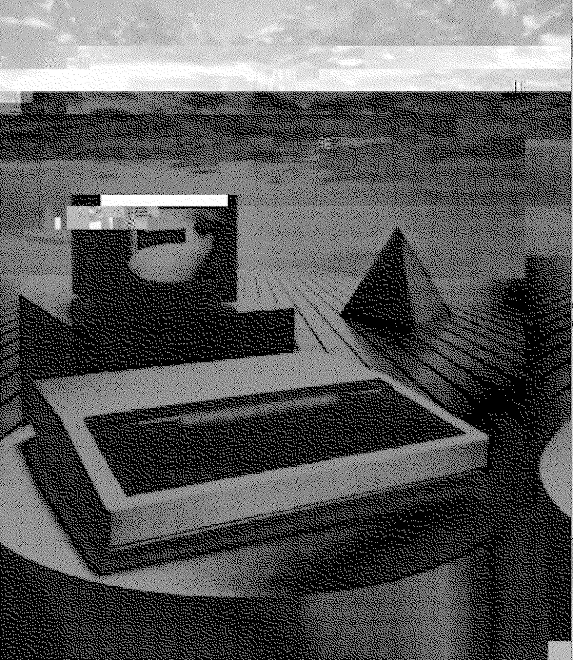
I've had a minor polygon obsession with my work recently, it seems to be that the first things I start drawing are triangles, rhombuses, etc. I thought it would be cool to experiment using bitmap-image creating software, rather than all the vector ones i'd been using previously. This way I could be alot more detailed, using more rudimentary software like microsofts Paint application and the Mac alternative Paintbrush. These were so much fun to use, i guess because it felt so much more like real drawing in comparison to vector programs, everything was kind of more in MY hands rather than the softwares. This took a lot longer than I'd hoped...

Basically what I did, because the software is like super lo-bit you can zoom in (up to 1600%) and click, using the paintbrush or line tool, adding colour literally bit by bit.

The process was pretty long, and you'll notice the many little imperfections the closer you zoom in, everything blends pretty well from a distance. Working with something like paint made me feel a little more like it was me, rather than the computer doing the work, like I was a lot more in control of how things were going to look, similar in that sense to screen printing. There something far more satisfying about you kind of 'instructing' the computer to do certain things, and not just working with in the confines of a certain piece of software.

iii

iii from Tina Frank on Vimeo.

Composed from the data from doc files

Thursday, November 12, 2009

John Baudrillard 'The Precession of Simulacra'

This text wasn't initially an easy read, but once I got my head round Baudrillard's simulation theories and the very dated reference points he used (for some of his theories), it was very insightful and helped shaped my understanding of simulacra in a social context.
Baudrillard has an incredibly negative opinion when it comes to simulacra, his theory is that in the Precession he discusses the simulation will finally result in the demise of that which it simulates. This is the process of 'Pure Simulacrum'

"-It is a reflection of a basic reality
-It masks and perverts a basic reality
-It masks the absence of a basic reality
-It bears no relation to any reality."

In reference to software I've explored so far Corel Painter would perhaps - unlike other pieces of creative software I had used - sit in an earlier stage of the 'Precession' Baudrillard describes. What I mean is that it reflects basic reality more so than anything else I have come across so far, Corel Painter was a more rational mutation of the real artists studio. In the instance of Illustrator or much of the Open Source software I've used, they've transcended the need to appear 'real' as Baudrillard puts it..
"It no longer has to be rational, since it is no longer measure against some ideal or negative instance."
It is not expected of these virtual environments, they're capabilites transcend the need to do to have an obvious reference to any basic reality.
In terms of the aforementioned negativity towards the simulation, Baudrillard sights more cultural referents. He touches on some interesting points, the idea of a simulated acceptance of a culture - such as Native Americans - Baudrillard mentions the colonisers, the 'modern' American immigrants, use this acceptance as "proof of superiority of civilisation". The simulated acceptance of a culture ultimately destroys that culture
"Demographic 'mutation', therefore is just one more step towards symbolic extermination."
Its interesting in a design context, to look at Baudrillards theory of Operational Negativity
"..a hormonal treatment of negativity and crisis. It is always a question of proving the real by the imaginary, proving the law by transgression, proving work by strike, proving the system by crisis.."
If we consider in a less extreme context the emergence of 'simulated' computer-based artwork as the crisis, more traditional 'real' methods are the treatment. I think digital environments are unavoidable in the design world - a lot of designers will use methods such as screen printing, monotype, dry point and hand drawn work as a reaction (conscious or unconscious) to the emergence of the of computer based art. 'Real' art is only 'real' because it is measured against that which comes from the 'unreal'. Through the operational negativity of digitally produced art it proves its reality through the "dispossesion of its object" that is computer art. these traditional methods need computers as a reference point in order to be traditional, sought after methods, without computers, surely this kind of art would be the 'unreal' considering in itself most artistic creation is traditionally a reflection of basic reality in the first place and is in fact a simulation.
So what does that make computer based art? A simulation of a simulation of a simulation of a...?
I think it is important not to take Baudrillards work out of context as he refers mainly to cultural simulations in 'The Precession..'. That aside reading this text has been very inspiring in the development of my critical and artistic theory.

All quotes: Baudrillard; Jean, 1983. Simulations: The Precession of Simulacra. trans. P Foss, P Patton. Semiotext[e], New York.
Screenprinting Illustrator Work Pt. II

Round two; my first CMYK printing experience was really, really frustrating at first. I assumed that process colours were just mixed in a similar manner to spot/pantone, and stupidly decided to use my initiative and began just mixing process colours, before being looked at like an idiot and told that precise measurements were needed.
This was after I'd printed out several positives from the computer at a dpi that was far too fine for CMYK. After these two mishaps, I began printing Yellow first - assuming again, like spot colours, that lightest comes first, and had to clean up and start again. Of course these all seem pretty obvious now, but I guess I couldn't of worked these out otherwise and the more annoying way I find out the more likely I am to remember these things in the future.
Anyway, the finished product came out so, so much better than the first spot-colour piece, this was owed almost entirely to the Registration Marks. Being a total nerd I actually appreciate the aesthetic of this kind of left-over working, however as helpful as these were in lining the work up perfectly, I can't imagine if any commissioned screen printing work came about that the presence of these in the finished piece would be an option. A majority of the staff in Vernon Street kept pushing me to tape them up because they would be 'unsightly'. So I guess I would have to perhaps crop them out in the future.


Colour-wise I'm really happy with the finished piece as well, having not printed CMYK before I was unsure how similar to the original on-screen piece the colours would look, but I think they look amazing despite the lack of likeness. I guess this was kind of a happy accident - but I've learnt a lot from it. Now that I know the aesthetic differences between the two as well as the practical, I feel comfortable about making judgements on the appropriate process for future work in the screen printing studio and the fact that there's a huge amount of options available for me to engage with dependent on the work I would like t produce.


Tuesday, November 10, 2009

Team Print


Our groups' little day trip that Paul organised to Team Print studios was actually incredibly inspiring. It made me realise not only how much of an industry their was and how much graphic designers rely on something like this, but also the amount of different processes, technology and possibilities there was in a well equipped digital print warehouse like this. The dude that took us around was really friendly, he gave us presents and drove us home, it was the best day ever. The warehouse was massive, I didn't expect anything like that size, but as far as it seemed Team Print were a pretty successful company; they had a decent flow of jobs coming from all over the UK. What was good to hear was how closely they worked with designers, like you could take work for mock-ups and try a few different processes until you got it the way you want it. There was a huge array of different printers for big and small jobs, a lot of the different printing techniques were well over my head, it was a whole new world to me, but in a good way.

It looked like the future for print studios like Team Print was the proper massive ink jet style digital printers, that printed continuous lines rather than dots like on a normal litho printer. At the moment they can only do up to A3 and were a lot better for smaller jobs but they definitely produced much higher quality prints, so it was interesting to see that in action. Also, some of the work like templates for business cards needed to be done through other businesses so felt like that was a little bit of an insight into how the industry worked.

Wednesday, November 4, 2009

Corel Painter

Corel Painter is a very strange creative virtual environment, its as if the developers attempted to create as 'true-to-life' a piece of software they could create. You can mix paints, choose an almost infinite range of brushes, pens, pencils, different canvas textures, its a pretty complex software. It's weird that can you use all these 'life-like' tools but it includes the more 'unreal' tools like the paint bucket and an eraser that rubs out any style of brush plus you can position any brush strokes as layers like Photoshop/Illustrator. I set up a few custom brushes just to see what sort of strokes they would create...


So, I spent some time changing the canvas settings and varying brush pressures, mixing colours and seeing what different kinds of virtual marks I left onscreen - keep in mind that this is just exploration and experimentation, clearly not me at the height of my artistic capabilities...


I can't say I felt immediately comfortable with this piece of software as a whole, thats not to say with more time spent on it I couldn't get used to using it and I would like to, considering the insanely complex work thats been produced by artists using it. The main problem at first was that this was also the first time I had used a graphics tablet and it didn't recognise the different brush pressures so I had to download the drivers for it from the Wacom website. After that it worked alot more smoothly but I still found the whole experience a little strange, using the tablet instead of a track pad, I think even using a mouse feels a little weird now that I'm so used to the feel of it.


However it's clearly worthwhile practicing using this, I reckon I'm going to get one of the new Wacom Bamboo Pen tablets just so that I can sit on my computer and get as used to as I have with a track pad. There's a world of difference between taking it out from college every so often and actually having one of your own. The only reason I'm comfortable with Photoshop - and now Illustrator - is just having it there with the freedom to practice and explore whenever I have the time.


Interview with Bill Kendrick

So I messed about with Tux Paint wrote about it on this blog and get a comment from its lead developer!
After emailing Bill he very kindly agreed to do a little interview with me on issues I was considering, when looking at the kind of critical/contextual aspects of communication technology and the idea of 'social change' mentioned in the brief. Was really inspiring talking to someone with some real experience in developing creative technology...

1. How do you feel the software you've developed has effected creative practice, do you take into consideration (big or small, positive or negative) its social/cultural ramifications?
I'm not sure how Tux Paint has affected the creative process as a _whole_, but I suppose it's given a lot of young kids the opportunity to play with computer art who may have not had the chance otherwise. For some adults (myself included), the somewhat limited functionality (compared to, say, Photoshop) actually makes it easier to be creative.

From another perspective, since Tux Paint is multilingual and used by kids around the globe, we do have to consider cultural differences of our users. We sadly haven't done much in that direction yet, but there are a collection of tasks, changes and enhancements sitting on the copious number of 'back burners' a project like this amasses.

2. Do you take a particular audience into consideration when developing software, how do you go about communicating the ideas behind your software?
For Tux Paint, definitely. I assume it will be used by very young kids, and try to make it easy to use without too much assistance. Obviously, since it's more than just a big emtpy screen to paint on -- there are multiple tools, load/save, undo/redo, colors, etc. -- the youngest users will need some help. I've tried to design things in such a way as to not confuse or frustrate them, though.

3. Your background is in computer science, so what lead you to become a more creative developer ie. stuff like games and tux paint?
It really went the other direction. I started playing video games on the Atari VCS (2600) back in the early 1980s, and was given my own computer as a kid. I learned to program BASIC, and spent a lot of time trying to re-implement the games I liked from the game console, games I had seen elsewhere but didn't have on my own computer, and of course creating games based on my own ideas.

I went into computer science because I knew I wanted to be a programmer, and was especially interested in making games. So far, I've only done it professionally for a short amount of time (less than 5 years), and I'm doing web application development again at the moment.

Aside from Tux Paint, I've created a number of other open source games. By far, Tux Paint's been the most popular, in terms of both users and gathering volunteers to help contribute.

4. What do you see in the future for creative technologies, educational software in particular?
Being an open source advocate, you won't be a surprise to hear me say that open source is important, especially in education. There are many open source applications that are suitable for educational use -- GIMP, Inkscape and Tux Paint for graphics, as well as OpenOffice.org (office suite), Stellarium, Celestia, KStars and Marble (astronomy and mapping), and hundreds of others.

Being open source means both no cost and no licensing issues; run it on as many systems as you like, without using any of the school's budget or going through the slow procurement process that school districts usually require. Open source apps are alsooften cross-platform, meaning you can run them on Windows, Mac or Linux.

Now think about this: when teachers want kids to be able to access the same application at home as they do at school, open source means worrying a lot less (if at all) about: cost, compatibility, piracy and viruses & spyware.

So Tux Paint is just a drop in the bucket. It's a fun one, though. ;)