Showing posts with label critical. Show all posts

Saturday, November 14, 2009

'Glitch Aesthetics' Iman Moradi

Glitch Aesthetics (available here) is adissertation documenting and analysing the glitch as an art-form. Iman Moradi categorises the visual glitch in two criteria: 'The Pure Glitch' and 'The Glitch-Alike', defined below..


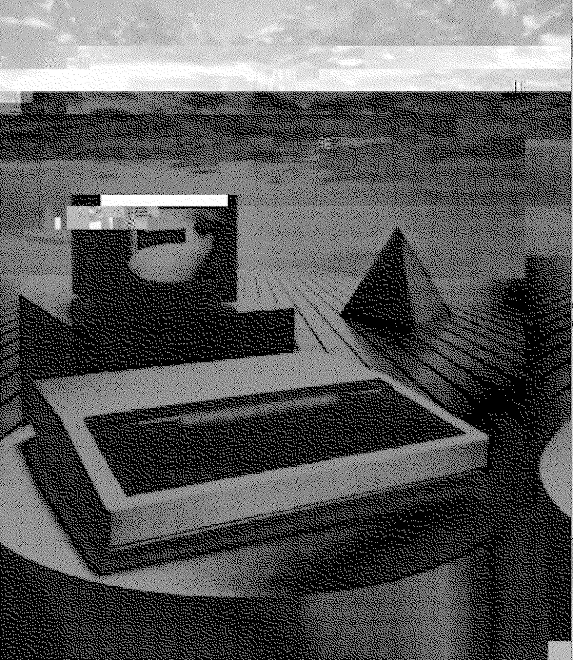
This was interesting because I imagine like many art forms the glitch would have been discovered by accident, like no-one 'invented' the glitch, I guess there was just an increase in appreciation for the aesthetics of the glitch. And of course now people like myself actually seek out ways to create these accidents. Moradi spends some time discussing the glitch as a communication, or a way of representing a meaning. An example he uses is the corruption of the 'perfect' image in a media portrayal celebrity (see below)..

Moradi traces the glitch back to cubism and references artists like Jackson Pollock in relation to the planned accident of Glitch-Alikes. He makes interesting comparison to both art forms (cubism and the glitch) as a fragmentation of reality, but in what context is the 'real' imagery reality? To me, Picasso's later work is as real as his earlier more 'true-to-life' etching work, in cubism, reality is just represented in a different form. The exploration of communication error between man and machine - that causes the sort of glitches I have generated - creates a visual from what is to the human-eye a non-visual, it is merely the computers visual interpretation of data.
Moradi makes a really good point that kind of sums up the way I'm feeling about the exploration I've been doing recently. When talking about the aforementioned 'representational' glitch-alikes, he makes the point that without a "...source image the glitches would simpy not exist."
Basically I just feel kind of like I'm corrupting, or in an even more pessimistic sense, tinkering with ready-made work, which I guess is why I was desperately using work I'd previously created rather than someone else's. I can't decide whether or not this is a good way to start understanding a computers programming language.

The The Best of Creative Computing Volume 3 (1980)


Something from the Atari Archives, a book published in 1980 compiling the best of the 1977 issues. Its kind of like a Comm Tech of the era, pulling together an assessment of the possible futures of the technology of the time and reviewing its social and cultural consequences. There is some fascinating analysis of the technology of the time as well, a lot of which still seemed relevant to the technology of today. you can read it all here.


"Electronic music studios predated computer art studios, leading a number of visual artists to seek information about computers from university music departments."

There's such a natural connection between the visual and the audio side of creative computing, they just seem to go hand in hand. Plus it's funny because there's amazing similarities between the two, like the emergence of computer based art was most prevalent in Germany and America - the first Computer Art exhibitions were held in New York and Stuttgart - two countries where electronic and synthesizer based music was at its most innovative by far. And the connection is more than relevant today, visuals have become an integral part of any forward thinking club night, Britain's most established electronic label Warp has an incredible array of computer based artwork, interactive art and web orientated visuals, plus there's so much software available that ties the two together.

Another quote I like that is still applicable to today's creative practice was the reference to the computer as

"..a tool for enhancing the on-the-spot creative power and productivity of the artist by accelerating and telescoping the creative process and by making available to its user a multitude of design options that otherwise might not occur to him"

Still totally true when considering the increasing availability and accessibility of creative tools, allowing artists complete spontaneity with their work, a computer can completely change the user's perspective on a project just by purely using certain software.

In reference to the 'glitch' work I've been doing this totally grabbed me, the idea of using computers to...

"...produce combinations of forms never seen before, either in nature or in museums, to create unimaginable images."

Of course the more aware of computer art you are, especially now rather than 1980, things become less 'unimaginable'. But every time I try something new I feel like I'm creating forms I've never seen before, forms I didn't even know I could generate.

Qubik Reverberations


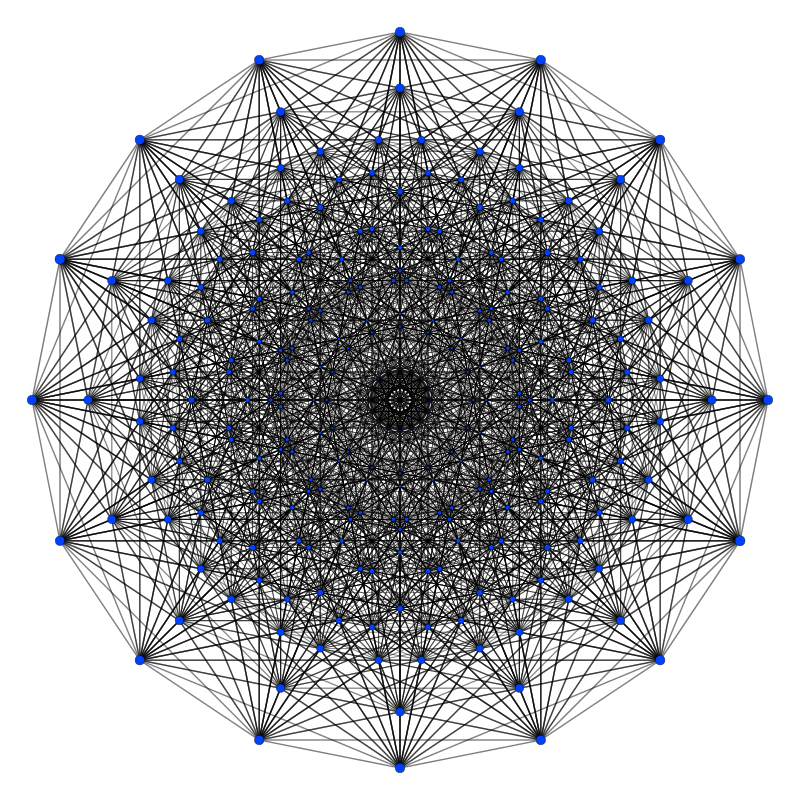
These images are all on invites for a series of events/workshops, entitled Reverberations. The word is used as a metaphor for the initial influences of the work the featured artists' now produce, my assumption is the artists' are the reverberations of this influence. Apparently the images were generated as a direct relation to this theme. I like the fact that a lot of work i've come across recently has been described as 'generated' rather than created, I reference to the coded element rather than an artist 'drawing' or 'painting', like there's more of a 'science' to it. For example, when I was doing as much geometry-related research as my brain could take in, I found an article on a 'Demienneract' or a '9-demicube'.

Basically what happens when you click on this link you are shown a preview of the image in the SVG format mentioned in an earlier post, so rather than what usually happens when you right-click/ctrl-click an image (ie. option to 'save image as...' or whatever), it allows you to view the image source. When the source code is viewed is there is an insane amount of x and y heights, showing the painstakingly numerically constructed images code. There's a real balance between maths and art.

Translab


After hours of scrolling through the goldmine that is this site , its become pretty apparent that the history of computer art lies within a creative community of mathematicians and scientists.

One of the standouts for me was Herbert Franke who created amazing amorphous structures using random number generators and mathematical problem-solving techniques to create numerically-controlled works.


Edward Zajec's work reminded me of the image source deconstructions I've been working on
- the have a kind of broken logic to them. Except instead of deleted chunks of text, Zajec uses an IBM 1620 computer to distribute linear elements on a rectangular lattice in different spatial and rhythmic combinations according to varying probabilities of occurrence.'
No me neither.

Glitch // Image Sources

I picked this up in Analogue Books in Edinburgh, it was like a load of artists who had kind of found 'wrong' ways to produce computer generated imagery. Some of the works were a lot more impressive 'looking' than others, but the ones that weren't seem to have more interesting contexts or techniques involved in their creation. It made me realise how little I knew about creating work on computers, so many of the techniques were well over my head, terms I'd never even heard of before - and I kind of saw myself as the biggest computer geek out of most of my friends - clearly I've got nothing on these people. Like, I can use software all I want as a means to create certain things, I can work out what does what on pretty much anything - but I've no idea what lies behind it, all the terminology, codes and numbers mean so little to me.
Of what I could understand, I tried to see what I could do for myself, I noticed that a lot of the works were things 'forced' into wrong programs, opened in incorrect formats, so I attempted this in the only way I understood it. The images below were photographs I took for Ballers Social Club in Glasgow (the originals are among the rest here), which I opened in text edit, the code was then altered (deleted, parts copied and pasted into the wrong places etc.) and then saved as a jpeg, sometimes this worked sometimes it didn't, it was a proper trial and error process. Mainly because no sane person could recognise what any of this meant...


I think these are the most successful source edits


The more I deleted the more unrecognisable the images became.
By the way I chose an electronic club night because it seemed appropriate, it wasn't just a random selection of images, one of the bands booked played on a load of broken synthesizers - go figure.
One thing I noticed was that you had to leave the majority of the top, say, quarter of the source well alone if you wanted any visible results, clearly this is an essential element of the code i guess. For example....

Wrong in a bad way??

Thursday, November 12, 2009

John Baudrillard 'The Precession of Simulacra'

This text wasn't initially an easy read, but once I got my head round Baudrillard's simulation theories and the very dated reference points he used (for some of his theories), it was very insightful and helped shaped my understanding of simulacra in a social context.
Baudrillard has an incredibly negative opinion when it comes to simulacra, his theory is that in the Precession he discusses the simulation will finally result in the demise of that which it simulates. This is the process of 'Pure Simulacrum'

"-It is a reflection of a basic reality
-It masks and perverts a basic reality
-It masks the absence of a basic reality
-It bears no relation to any reality."

In reference to software I've explored so far Corel Painter would perhaps - unlike other pieces of creative software I had used - sit in an earlier stage of the 'Precession' Baudrillard describes. What I mean is that it reflects basic reality more so than anything else I have come across so far, Corel Painter was a more rational mutation of the real artists studio. In the instance of Illustrator or much of the Open Source software I've used, they've transcended the need to appear 'real' as Baudrillard puts it..
"It no longer has to be rational, since it is no longer measure against some ideal or negative instance."
It is not expected of these virtual environments, they're capabilites transcend the need to do to have an obvious reference to any basic reality.
In terms of the aforementioned negativity towards the simulation, Baudrillard sights more cultural referents. He touches on some interesting points, the idea of a simulated acceptance of a culture - such as Native Americans - Baudrillard mentions the colonisers, the 'modern' American immigrants, use this acceptance as "proof of superiority of civilisation". The simulated acceptance of a culture ultimately destroys that culture
"Demographic 'mutation', therefore is just one more step towards symbolic extermination."
Its interesting in a design context, to look at Baudrillards theory of Operational Negativity
"..a hormonal treatment of negativity and crisis. It is always a question of proving the real by the imaginary, proving the law by transgression, proving work by strike, proving the system by crisis.."
If we consider in a less extreme context the emergence of 'simulated' computer-based artwork as the crisis, more traditional 'real' methods are the treatment. I think digital environments are unavoidable in the design world - a lot of designers will use methods such as screen printing, monotype, dry point and hand drawn work as a reaction (conscious or unconscious) to the emergence of the of computer based art. 'Real' art is only 'real' because it is measured against that which comes from the 'unreal'. Through the operational negativity of digitally produced art it proves its reality through the "dispossesion of its object" that is computer art. these traditional methods need computers as a reference point in order to be traditional, sought after methods, without computers, surely this kind of art would be the 'unreal' considering in itself most artistic creation is traditionally a reflection of basic reality in the first place and is in fact a simulation.
So what does that make computer based art? A simulation of a simulation of a simulation of a...?
I think it is important not to take Baudrillards work out of context as he refers mainly to cultural simulations in 'The Precession..'. That aside reading this text has been very inspiring in the development of my critical and artistic theory.

All quotes: Baudrillard; Jean, 1983. Simulations: The Precession of Simulacra. trans. P Foss, P Patton. Semiotext[e], New York.

Wednesday, November 4, 2009

Interview with Bill Kendrick

So I messed about with Tux Paint wrote about it on this blog and get a comment from its lead developer!
After emailing Bill he very kindly agreed to do a little interview with me on issues I was considering, when looking at the kind of critical/contextual aspects of communication technology and the idea of 'social change' mentioned in the brief. Was really inspiring talking to someone with some real experience in developing creative technology...

1. How do you feel the software you've developed has effected creative practice, do you take into consideration (big or small, positive or negative) its social/cultural ramifications?
I'm not sure how Tux Paint has affected the creative process as a _whole_, but I suppose it's given a lot of young kids the opportunity to play with computer art who may have not had the chance otherwise. For some adults (myself included), the somewhat limited functionality (compared to, say, Photoshop) actually makes it easier to be creative.

From another perspective, since Tux Paint is multilingual and used by kids around the globe, we do have to consider cultural differences of our users. We sadly haven't done much in that direction yet, but there are a collection of tasks, changes and enhancements sitting on the copious number of 'back burners' a project like this amasses.

2. Do you take a particular audience into consideration when developing software, how do you go about communicating the ideas behind your software?
For Tux Paint, definitely. I assume it will be used by very young kids, and try to make it easy to use without too much assistance. Obviously, since it's more than just a big emtpy screen to paint on -- there are multiple tools, load/save, undo/redo, colors, etc. -- the youngest users will need some help. I've tried to design things in such a way as to not confuse or frustrate them, though.

3. Your background is in computer science, so what lead you to become a more creative developer ie. stuff like games and tux paint?
It really went the other direction. I started playing video games on the Atari VCS (2600) back in the early 1980s, and was given my own computer as a kid. I learned to program BASIC, and spent a lot of time trying to re-implement the games I liked from the game console, games I had seen elsewhere but didn't have on my own computer, and of course creating games based on my own ideas.

I went into computer science because I knew I wanted to be a programmer, and was especially interested in making games. So far, I've only done it professionally for a short amount of time (less than 5 years), and I'm doing web application development again at the moment.

Aside from Tux Paint, I've created a number of other open source games. By far, Tux Paint's been the most popular, in terms of both users and gathering volunteers to help contribute.

4. What do you see in the future for creative technologies, educational software in particular?
Being an open source advocate, you won't be a surprise to hear me say that open source is important, especially in education. There are many open source applications that are suitable for educational use -- GIMP, Inkscape and Tux Paint for graphics, as well as OpenOffice.org (office suite), Stellarium, Celestia, KStars and Marble (astronomy and mapping), and hundreds of others.

Being open source means both no cost and no licensing issues; run it on as many systems as you like, without using any of the school's budget or going through the slow procurement process that school districts usually require. Open source apps are alsooften cross-platform, meaning you can run them on Windows, Mac or Linux.

Now think about this: when teachers want kids to be able to access the same application at home as they do at school, open source means worrying a lot less (if at all) about: cost, compatibility, piracy and viruses & spyware.

So Tux Paint is just a drop in the bucket. It's a fun one, though. ;)

Thursday, October 22, 2009

A Visual Reference


An example of how technology allows us to 'see' the 'unseeable'

Wednesday, October 21, 2009

'Narrative As Virtual Reality'


So I've been reading 'Narrative As Virtual Reality' by Marie-Laure Ryan, its basically a discussion of the social/cultural influence of various electronic media with reference to people like Baudrillard and Pierre Levy. In one of the earlier chapters Ryan talks of the "quasi-human" language that computer programs are written in - a kind of binary code translation for non zero one zero zero people-brains. I think it's funny when you start looking at the software we use, how we need all these reference points to understand what certain 'tools' are for, like how you can turn your 'paintbrush' into a 'magic wand' in a single click. In some ways these are reference points in others, computers are programmed in order to simulate specific tools of the 'real world'...
"As a machine a computer has no intrinsic function. Through its software however, it can simulate... existing devices and human activities, thus becoming a virtual calculator, typewriter, record player, storyteller, teacher, bookkeeper or adviser.."
I like the idea that we need a visual reference point in order to understand how something works, that programs have to be 'designed' with complete human accessibility in mind. I think this extends much further than the computer world, for example in the science world, in textbooks we are given diagrams of what atoms and protons 'look like', of course they don't look like anything we could ever imagine, just as in the complete opposite end of the spectrum trying to picture the shape and size of the expanding universe, or what lies outside the universe, what 'nothing' looked like before the big bang etc.
"We live in simulacra because we live in our own mental mode of reality. What I call "the world" is my perception and image of it."

In this case we need a 'virtual' depiction to understand what these things are, a necessary simulacra. Our view of an atom is not "reality", as humans we cannot "see" atoms but we can envision them only by use of a referent. This is not necessarily unreal, just our interpretive model of the real in order to understand "genuine" reality. With this view in mind, the progression of technology in creating 'virtual' learning environments, is a positive one, it allows us to be creative in ways we couldn't possibly be before, a greater sense of accessibility and interactivity in world's of virtual film editing and design studios, paint buckets and swirl tools. Through these visual reference points artists' with no knowledge of coding or computer programming can use various creative means to explore our view of "the world" as we see it.

All quotes
Ryan; Marie-Laure, 2001. Narrative as Virtual Reality: Immersion and Interactivity in Literature and Electronic Media. John Hopkins University Press, Baltimore.

Sunday, October 18, 2009

Tux Paint


So this is like free software for kids to mess with in school, so it was kind of just fun messing with it, no REAL work could really come out of it. The software in itself was quite a well put together piece of work, the rainbow tool was cool as hell (see top pic) and there was a lot of fun little 'magic' tools along with a helpful, albeit slightly demented looking penguin. It also makes sure you when you quite that you definitely, DEFINITELY don't want to save work, and I know that when i was playing with stuff like this in primary school I would quite by accident all the time and go crazy over it, so thats gonna be helpful for kids. You also can't save/export any work as any kind of useful format. So anything that I may use from this has to be screenshotted.

I guess this kind of made me think the whole 'hyperreal' concept of virtuality (see post above), in terms of arts and crafts classes I remember getting in primary, you know, finger painting, making pictures of fireworks by scratching black paint of crayons, that sort of thing. I'm not sure how much virtual painting and creative software for children is used in primary schools, nurseries etc. but it's interesting to think that this could perhaps replace the 'real' hands-on kind of creativity. Whether there will be a development in more accessible children's computers rather than just software, and whether A-Level/Higher Art teachers will have to have experience in digital arts such in order for stuff like Photoshop and Adobe Illustrator to be taught as part of the basic education curriculum?

Friday, October 2, 2009

Avatars


So I've been reading 'Alter Ego: Avatars and their creators'. It gives a really interesting insight into the reasons people immerse themselves in virtual worlds, some of the people featured in the book made money of purely playing games in order to up the level of other peoples' characters'. Others found it as an escape route from the problems in the 'real world'. This was quite a poignant quote from the books' introduction by Julian Dibbell;
"We fall in love there. We lust for power and for wealth. We seek adventure and escape from the tedium of our more enduring, realer lives. We say they're only games, these little worlds, but often we end up devoting more time to them than to any other realm of our existence, until it starts to make less sense to think of our avatars as fictional characters than as our second selves..."
It's kind of daunting thinking of the possibilities the future holds for this kind of immersive gaming culture, like what sort of level of virtual worlds will people 'play' in in years to come. However, I think its important to add that there is the more accessible, interactive, kind of more passive gaming offered by the Wii, PSP etc.

Concept

Although this brief focusses on the process and exploration rather than a particular concept, I thought I'd lay one down in order to give me a little bit of direction...
I plan to explore the world of 'simulations', whether this be gaming culture, the digital versions of nearly every aspect of creativity and our progression into a 'virtual reality'. In order to create work that reflects this concept, I plan to look at, and work with artists and communicators involved in this industry and explore appropriate technologies and software to create relevant visuals.
I don't want to get too tied down to the concept so I want to keep it slightly open so that it can be used in a way that allows me to explore communication technologies important to me as a graphic designer.