Saturday, November 14, 2009

'Glitch Aesthetics' Iman Moradi

Glitch Aesthetics (available here) is adissertation documenting and analysing the glitch as an art-form. Iman Moradi categorises the visual glitch in two criteria: 'The Pure Glitch' and 'The Glitch-Alike', defined below..


This was interesting because I imagine like many art forms the glitch would have been discovered by accident, like no-one 'invented' the glitch, I guess there was just an increase in appreciation for the aesthetics of the glitch. And of course now people like myself actually seek out ways to create these accidents. Moradi spends some time discussing the glitch as a communication, or a way of representing a meaning. An example he uses is the corruption of the 'perfect' image in a media portrayal celebrity (see below)..

Moradi traces the glitch back to cubism and references artists like Jackson Pollock in relation to the planned accident of Glitch-Alikes. He makes interesting comparison to both art forms (cubism and the glitch) as a fragmentation of reality, but in what context is the 'real' imagery reality? To me, Picasso's later work is as real as his earlier more 'true-to-life' etching work, in cubism, reality is just represented in a different form. The exploration of communication error between man and machine - that causes the sort of glitches I have generated - creates a visual from what is to the human-eye a non-visual, it is merely the computers visual interpretation of data.
Moradi makes a really good point that kind of sums up the way I'm feeling about the exploration I've been doing recently. When talking about the aforementioned 'representational' glitch-alikes, he makes the point that without a "...source image the glitches would simpy not exist."
Basically I just feel kind of like I'm corrupting, or in an even more pessimistic sense, tinkering with ready-made work, which I guess is why I was desperately using work I'd previously created rather than someone else's. I can't decide whether or not this is a good way to start understanding a computers programming language.

RAW Files

So Christian casually announced that he was friends with Joe Gilmore - one of the main facilitators for Glitch: Designing Imperfection and qubik.com - who I've been talking to via email, which opened up a ridiculous amount of possibilities. First of all, there is the simple task of opening any file as a RAW file, simply by changing its file extension (ie. WAV, TXT etc.) to .raw, this means that any file can be turned into visual data. Once the file extension is changed the file is opened in Photoshop and you are given options on how you would like to view the file, ie. the dimensions (limited within the file size), the amount of channels, whether these channels will be interleaved or not, whether the image will be 16bit or 8bit.


Smaller files tend to just produce static, as far as I could work out this was because there were so few bytes it was impossible to produce more the one channel for the image, resulting in a monotone bitty mess...


However, large uncompressed files like could produce some really interesting imagery. This was actually my PPD presentation from last year, it had huge amounts of info, so there were far less limits in terms of the amount of channels etc. these are just a couple of experiments with the channel interleaving and dimensions, they produced some mad colourful static.


As I messed with larger files it became clear that there needed to be a bit more of a balance in file size. Many of the files had too much going on and ended up just looking like static as well, in order to generate more interesting patterns for example, this was a fully uncompressed wav of a track I recently finished (featured on this), the files like 33.9mb and produced similar levels of static...


So I tried a shorter track of the same bitrate, a synth laiden intro I created for a mixtape a while back, which created some really interesting patterns...


This was the first image that generated something that actually reminded me of the original file, it looks alot better zoomed in on as well, this was the image at 400% minus the yellow channel. Not sure what use any of these have, but I feel like they're kind of little baby steps towards actually understanding whats possible in terms of unorthodox creativity with computers.


Laura Brothers


I've spent hours looking at this artists' work, its so intricate and charming despite being so obviously created digitally.


I think one of the reasons I'm drawn to it is it reminds me of the graphics on the first computer my mum and dad bought, I think it was a Macintosh Classic as far as I can remember.


Theres an unusual harmony between user and computer in her work, theres no way it a computer could create as human a piece of work without an artists' influence and equally an artist would struggle to create this without a digital aid.

See more of her work here

The The Best of Creative Computing Volume 3 (1980)


Something from the Atari Archives, a book published in 1980 compiling the best of the 1977 issues. Its kind of like a Comm Tech of the era, pulling together an assessment of the possible futures of the technology of the time and reviewing its social and cultural consequences. There is some fascinating analysis of the technology of the time as well, a lot of which still seemed relevant to the technology of today. you can read it all here.


"Electronic music studios predated computer art studios, leading a number of visual artists to seek information about computers from university music departments."

There's such a natural connection between the visual and the audio side of creative computing, they just seem to go hand in hand. Plus it's funny because there's amazing similarities between the two, like the emergence of computer based art was most prevalent in Germany and America - the first Computer Art exhibitions were held in New York and Stuttgart - two countries where electronic and synthesizer based music was at its most innovative by far. And the connection is more than relevant today, visuals have become an integral part of any forward thinking club night, Britain's most established electronic label Warp has an incredible array of computer based artwork, interactive art and web orientated visuals, plus there's so much software available that ties the two together.

Another quote I like that is still applicable to today's creative practice was the reference to the computer as

"..a tool for enhancing the on-the-spot creative power and productivity of the artist by accelerating and telescoping the creative process and by making available to its user a multitude of design options that otherwise might not occur to him"

Still totally true when considering the increasing availability and accessibility of creative tools, allowing artists complete spontaneity with their work, a computer can completely change the user's perspective on a project just by purely using certain software.

In reference to the 'glitch' work I've been doing this totally grabbed me, the idea of using computers to...

"...produce combinations of forms never seen before, either in nature or in museums, to create unimaginable images."

Of course the more aware of computer art you are, especially now rather than 1980, things become less 'unimaginable'. But every time I try something new I feel like I'm creating forms I've never seen before, forms I didn't even know I could generate.

Qubik Reverberations


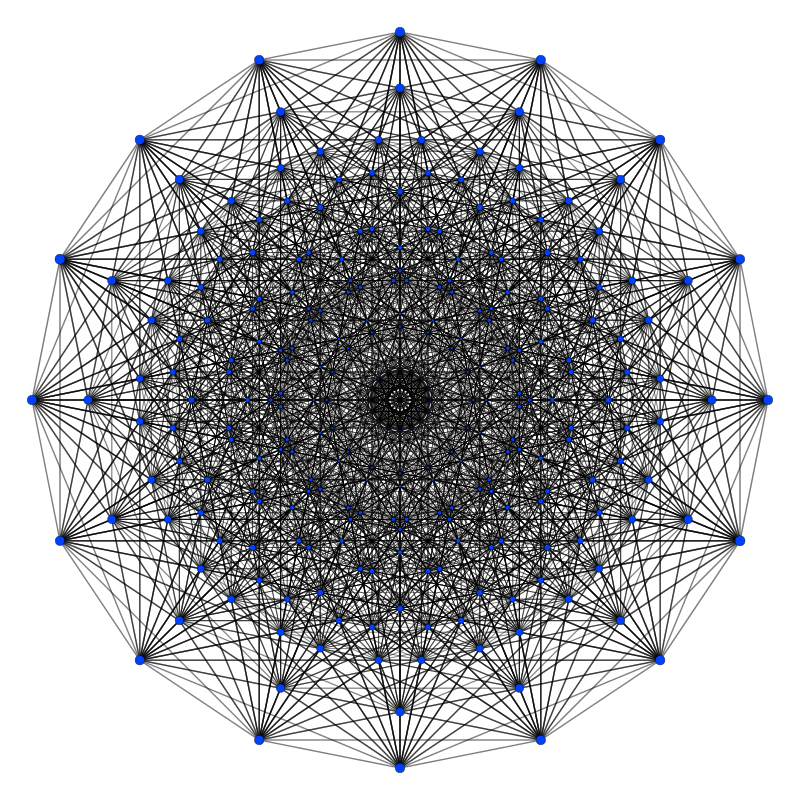
These images are all on invites for a series of events/workshops, entitled Reverberations. The word is used as a metaphor for the initial influences of the work the featured artists' now produce, my assumption is the artists' are the reverberations of this influence. Apparently the images were generated as a direct relation to this theme. I like the fact that a lot of work i've come across recently has been described as 'generated' rather than created, I reference to the coded element rather than an artist 'drawing' or 'painting', like there's more of a 'science' to it. For example, when I was doing as much geometry-related research as my brain could take in, I found an article on a 'Demienneract' or a '9-demicube'.

Basically what happens when you click on this link you are shown a preview of the image in the SVG format mentioned in an earlier post, so rather than what usually happens when you right-click/ctrl-click an image (ie. option to 'save image as...' or whatever), it allows you to view the image source. When the source code is viewed is there is an insane amount of x and y heights, showing the painstakingly numerically constructed images code. There's a real balance between maths and art.

Translab


After hours of scrolling through the goldmine that is this site , its become pretty apparent that the history of computer art lies within a creative community of mathematicians and scientists.

One of the standouts for me was Herbert Franke who created amazing amorphous structures using random number generators and mathematical problem-solving techniques to create numerically-controlled works.


Edward Zajec's work reminded me of the image source deconstructions I've been working on
- the have a kind of broken logic to them. Except instead of deleted chunks of text, Zajec uses an IBM 1620 computer to distribute linear elements on a rectangular lattice in different spatial and rhythmic combinations according to varying probabilities of occurrence.'
No me neither.

Glitch // Image Sources

I picked this up in Analogue Books in Edinburgh, it was like a load of artists who had kind of found 'wrong' ways to produce computer generated imagery. Some of the works were a lot more impressive 'looking' than others, but the ones that weren't seem to have more interesting contexts or techniques involved in their creation. It made me realise how little I knew about creating work on computers, so many of the techniques were well over my head, terms I'd never even heard of before - and I kind of saw myself as the biggest computer geek out of most of my friends - clearly I've got nothing on these people. Like, I can use software all I want as a means to create certain things, I can work out what does what on pretty much anything - but I've no idea what lies behind it, all the terminology, codes and numbers mean so little to me.
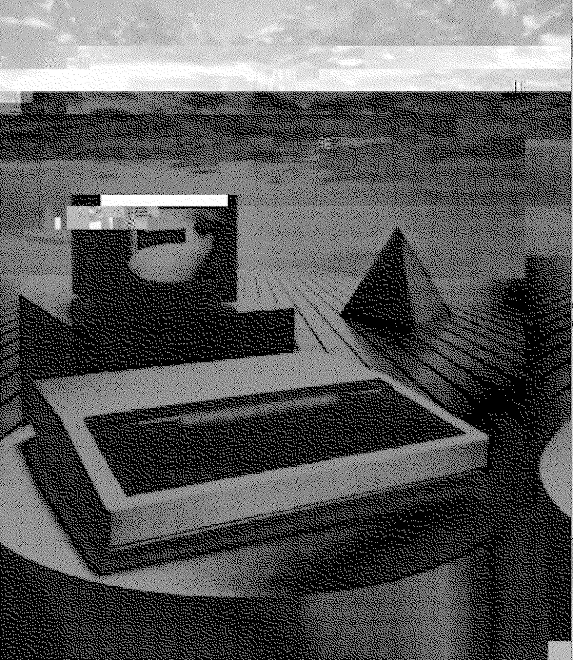
Of what I could understand, I tried to see what I could do for myself, I noticed that a lot of the works were things 'forced' into wrong programs, opened in incorrect formats, so I attempted this in the only way I understood it. The images below were photographs I took for Ballers Social Club in Glasgow (the originals are among the rest here), which I opened in text edit, the code was then altered (deleted, parts copied and pasted into the wrong places etc.) and then saved as a jpeg, sometimes this worked sometimes it didn't, it was a proper trial and error process. Mainly because no sane person could recognise what any of this meant...


I think these are the most successful source edits


The more I deleted the more unrecognisable the images became.
By the way I chose an electronic club night because it seemed appropriate, it wasn't just a random selection of images, one of the bands booked played on a load of broken synthesizers - go figure.
One thing I noticed was that you had to leave the majority of the top, say, quarter of the source well alone if you wanted any visible results, clearly this is an essential element of the code i guess. For example....

Wrong in a bad way??